Uncanny Valley In Anime Explained
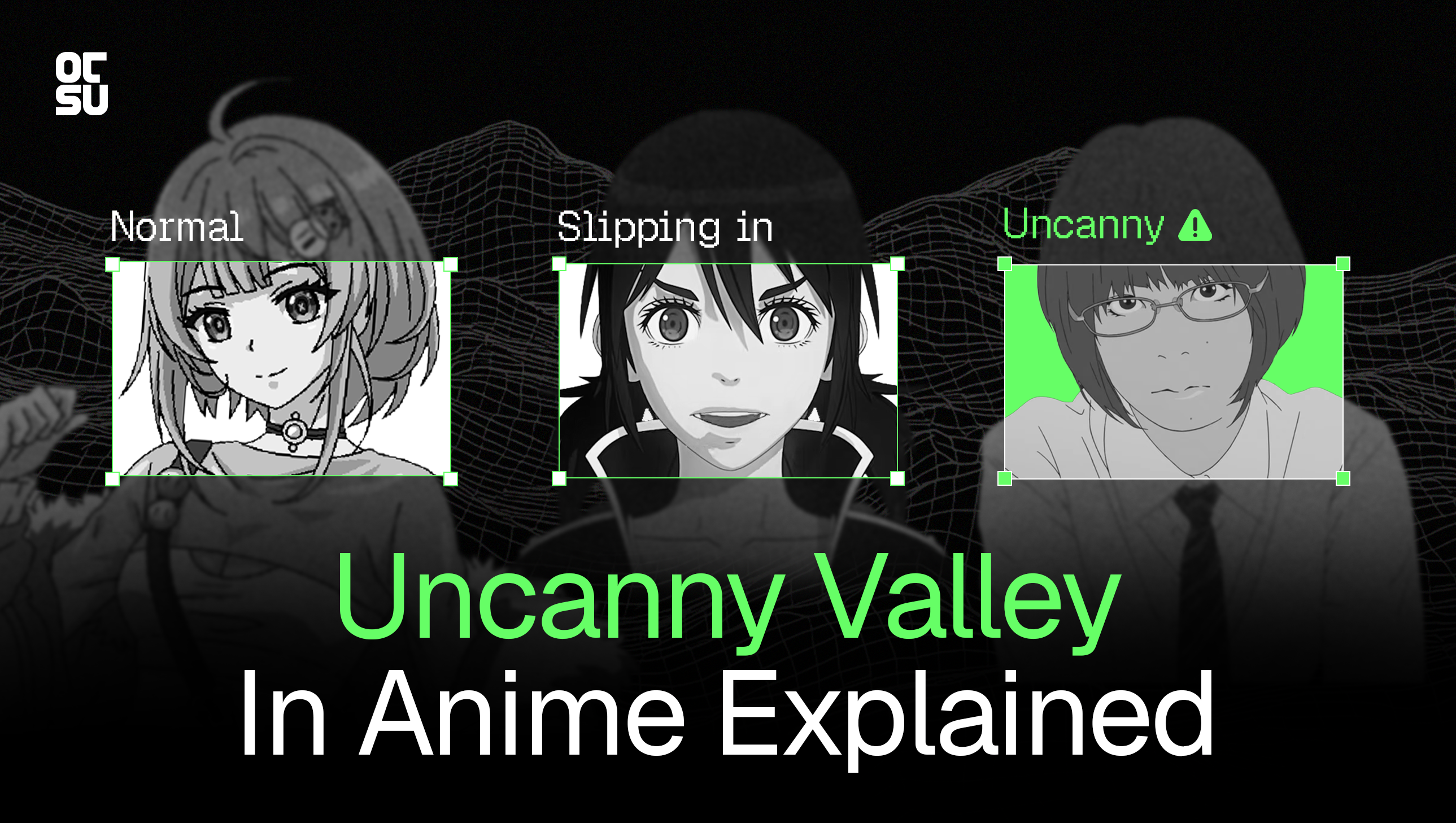
The uncanny valley can sink a character or make a horror story unforgettable. Using Masahiro Mori’s famous graph and case studies like The Flowers of Evil, Knights of Sidonia and Uzumaki, we explain how the effect works in anime and how animators can control it.
When “Almost Human” Is The Scariest Look Of All
Anime is about as far from photorealism as an art form gets. Characters have eyes the size of dinner plates, hair that ignores physics and noses that appear or disappear depending on the camera angle. By that logic, anime should be immune to the uncanny valley.
And yet.
Every so often, a series comes along that makes viewers squirm in a way they can't quite name. The characters look human and move like humans, but something feels quietly, deeply wrong. That feeling has a name: the uncanny valley.
In this guide, we'll explain what the uncanny valley is, why the anime art style usually keeps it at arm's length and what happens when anime falls in, whether by accident or on purpose. Along the way, we'll look at The Flowers of Evil, Knights of Sidonia and Junji Ito's Uzumaki and pull out practical lessons for anyone bringing animated characters to life.
What Is The Uncanny Valley?
The uncanny valley is the dip in comfort we feel when something looks almost, but not quite, human. The more realistic a character gets, the less we forgive its small flaws. A slightly stiff smile is charming on a cartoon and creepy on a near-perfect CG face.
Masahiro Mori And The Original Graph
The idea comes from Japanese roboticist Masahiro Mori, then a professor at the Tokyo Institute of Technology. In 1970, he published a short essay in an obscure Japanese journal called Energy, describing a phenomenon he called bukimi no tani, or "the valley of eeriness." It went largely unnoticed for decades before an authorized English translation brought it to a much wider audience in 2012.
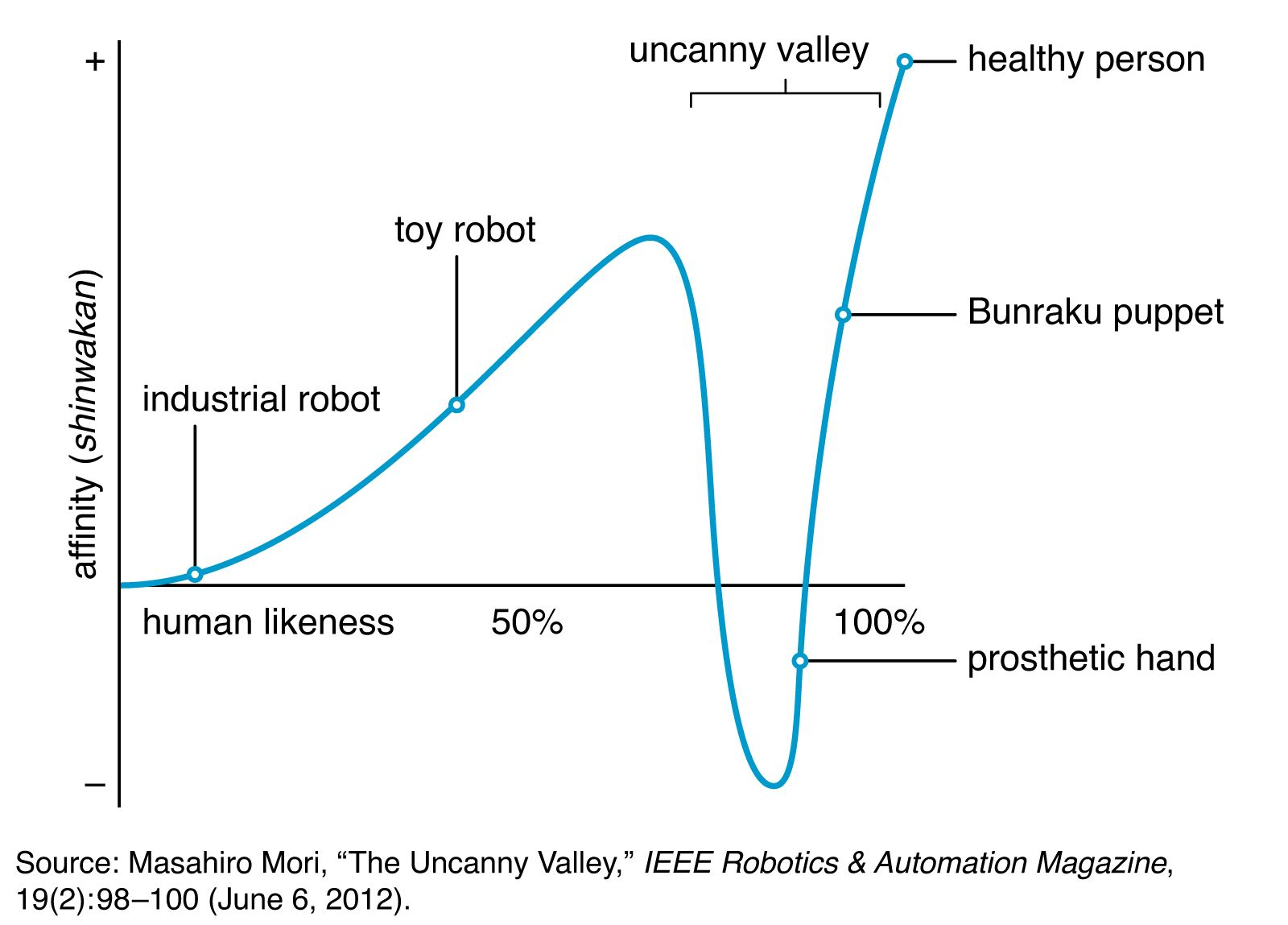
Mori's graph plots human likeness on one axis against shinwakan, usually translated as affinity or familiarity, on the other. Reading it from left to right:
- An industrial robot looks nothing like us, so it sits near zero. We feel very little toward it either way.
- A toy robot with a face and limbs climbs the curve. It's familiar enough to be likable.
- A prosthetic hand looks very human at a glance. But once you notice it's cold and lifeless, affinity plunges below zero. That plunge is the valley.
- A healthy human sits at the top of the second peak, on the far side of the valley.
Mori placed the corpse and the zombie at the bottom of the valley and argued that movement makes everything more extreme. A moving figure climbs higher on the peaks and sinks deeper into the valley than a still one. That point matters a lot for animation, an art form that is literally drawings in motion.
Interestingly, Mori also put the bunraku puppet, a traditional Japanese theater puppet, high on the first peak. Up close it looks nothing like a person. But from a theater seat, its stylized movement and expression make it feel alive. Keep that puppet in mind, because anime works in much the same way.
**Where Else The Uncanny Valley Shows Up**
Mori was thinking about robots, but his idea has since spread well beyond robotics. Android designers, video game studios and makers of digital humans and AI avatars all treat it as a design hazard.
Film offers the most famous cautionary tales. Final Fantasy: The Spirits Within (2001) and The Polar Express (2004) pushed hard toward photoreal CG humans and many viewers found the results eerie rather than impressive. More recently, the first trailer for the Sonic the Hedgehog movie (2019) sparked such a backlash over the character's too-human teeth and proportions that the studio redesigned him before release.
The lesson from all three is the same. Audiences are remarkably forgiving of characters that are obviously drawn and remarkably harsh on characters that are nearly real.
Why Anime Usually Stays Away From The Uncanny Valley
There are two ways out of the uncanny valley. You can climb all the way up the far side by being fully, convincingly realistic, which is expensive and hard to get right. Or you can stay safely on the near side by being stylized enough that nobody reads your characters as real humans in the first place.
Anime takes the second route and it has spent decades refining it. Like Mori's bunraku puppet, an anime character doesn't need to pass as human. It just needs to feel alive. Here are the features of the style that do most of the protective work.
Big, Simplified Eyes
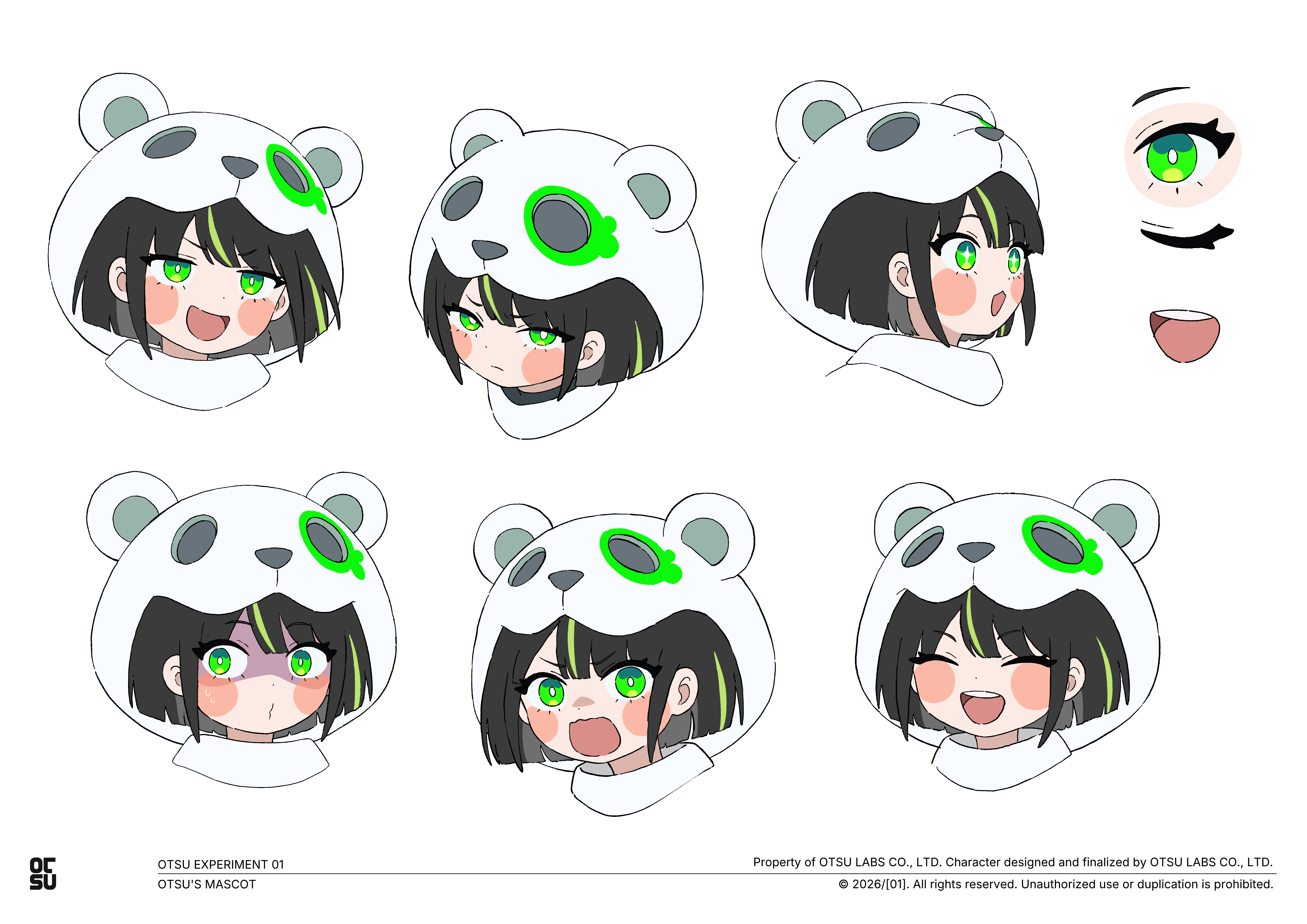
Anime eyes are oversized, graphic and expressive: a few shapes, a highlight or two and a bold outline. They carry emotion clearly without inviting the close inspection that realistic eyes get. Since “dead eyes” are one of the strongest uncanny triggers, simplifying them removes a major risk.
Minimal Noses And Mouths
Noses are often a single line or shadow and mouths change shape freely to fit the emotion. Because these features never try to look anatomically correct, they can't look anatomically wrong either.
Flat Color And Cel Shading
Blocks of flat color with hard-edged shadows tell the brain “this is a drawing” at a glance. There's no pore-level skin texture or subsurface glow to fall short of the real thing.
Limited Animation
Much TV anime is animated “on twos” or “on threes”, holding each drawing for two or three frames instead of one. That snappy, slightly stepped motion reads as deliberate style rather than a failed attempt at real human movement. Remember Mori's point that motion deepens the valley: anime simply doesn't compete with live action on its own terms.
For a closer look at the technique, see our guide to limited animation in anime.
Exaggeration And Visual Shorthand
Sweat drops, anger veins, chibi forms and faces that collapse into comedy doodles all push characters further from realism and audiences love them for it. Every exaggeration is a reminder that we're watching a cartoon and that's exactly why the emotion lands without the creep factor.
Consistency Is The Real Secret
None of these features works alone. What keeps anime safe is that all of them follow the same set of rules. The eyes, the shading and the motion all agree on how "real" this world is. As we're about to see, the trouble starts when one element breaks ranks.
That kind of consistency doesn't happen by accident. On a production with dozens of animators, much of it comes down to the sakkan role in anime: the animation director who corrects drawings so every character stays on model.
When Anime Falls Into The Uncanny Valley
So if the anime style is built to stay out of the valley, how do some anime still end up there? Almost always, one element of the production gets more realistic than everything around it and the illusion cracks.
Not Always A Mistake
“Falling into the uncanny valley” sounds like a failure, but it isn't one by default. Sometimes it happens by accident, when a technique or a budget pulls one layer of the animation out of step with the rest. Other times, creators walk in on purpose, because unease is exactly what the story calls for. Horror, psychological drama and sci-fi all have good reasons to make an audience feel that something is off.
The difference between the two is control. The examples below show both sides, which makes this section a guide to avoiding the effect and to using it.
Falling In By Accident
The usual suspect is 3DCG. Computer-generated characters can move with smooth, near-human precision and when the rest of the character can't keep up, viewers notice.
Berserk (2016) and Ex-Arm (2021) are two of the most often cited examples. Both drew heavy criticism for CG characters whose bodies moved stiffly or awkwardly while their faces stayed oddly blank, a combination that made them feel more like mannequins than people.
Knights of Sidonia (2014) is a more interesting case. Produced entirely in 3DCG by Polygon Pictures, it became Netflix's first original anime. Its CG shines in the finer details and in the mecha action scenes. But the facial expressions are limited, so moments of shock, fear and tension can feel subdued and wooden.
Here's the twist: in a cold, claustrophobic story about humanity barely surviving in deep space, that slight stiffness can actually work in the show's favor. Reviewers have noted that the unfamiliar CG look adds to the series' alien atmosphere. It's an accidental trip into the valley that the story ends up using.
The common mistakes behind accidental uncanniness:
- Faces that are less expressive than bodies. A character who moves naturally but emotes like a statue looks hollow.
- Motion that doesn't match the design. Realistic movement on a simplified character, or stiff movement on a detailed one, makes the two layers fight.
- Mixed rendering styles. CG figures dropped next to hand-drawn ones without a shared look make both feel out of place.
- Dead eyes. Eyes that don't catch light, track their target or shift with emotion are the fastest route to the valley floor.
Stepping In On Purpose
Now for the creators who walk into the valley with their eyes wide open.
The Flowers of Evil (2013), directed by Hiroshi Nagahama, uses rotoscoping for the entire series, tracing every scene from footage of real actors. The characters' faces are simplified, sometimes barely there, while their movement carries every small human detail. In a medium where we expect stylized motion, that much realism feels strangely out of place. For a story about adolescent obsession and alienation, that's precisely the point, even though the look famously divided fans.
The lesson isn't that realism is the problem. It's how much of it you let through. Rotoscoping copies every tiny human movement straight from the footage, while many anime animators draw realistic motion by hand, choosing which details of weight and timing to keep. To see how they pull it off, our guide to anime animation styles breaks down anime realism alongside the signature styles of legendary animators like Yoshinori Kanada, Norio Matsumoto and Yutaka Nakamura.
Junji Ito's horror manga gets its eeriness from a different trick: detail in the wrong place. Ito draws eyes in high detail, with individual lashes and light reflections, on faces that are washed-out and lack contour. The eyes feel too alive for the faces around them. Adult Swim's Uzumaki (2024), whose first episode Nagahama also directed, stays faithful to this. It keeps Ito's black-and-white look, combines rotoscoping with CG and uses many close-ups that keep the effect front and center.
The tools these productions use to create unease on purpose:
- Realistic motion on stylized designs, through rotoscoping or motion capture.
- Selective over-detailing of eyes, teeth or hands against otherwise simple features.
- Restricted facial expression, so emotions never quite reach the face.
- Lingering close-ups that force viewers to study features they'd rather look away from.
- Muted or monochrome palettes that drain warmth and life from the skin.
Key Takeaways For Creators
1. Pick your spot on Mori's curve before production starts. Decide whether you want charm, realism or unease and design toward it.
2. Keep every layer consistent. Design, rendering, motion and facial animation should all agree on how real your world is.
3. Spend your budget on faces and eyes. That's where audiences look first and forgive least.
4. Treat mismatches as a tool, not an accident. Realistic motion on a stylized design creates tension, so use it only where you want tension.
5. Aim the creep factor. Deliberate uncanniness works best when it's tied to specific characters or story beats, not spread across the whole show
Short on time? We packed this whole article into a one-minute Instagram recap. Give it a watch, then follow us there for more Anime Unknown in bite-sized form.
Getting Stylization Right With Otsu Animation
The uncanny valley isn't really about realism. It's about mismatch. Our brains forgive almost any style as long as it's consistent and they turn on a character the moment one detail tries harder than the rest.
That's why anime usually stays out of the valley. Its big eyes, flat colors, stepped motion and gleeful exaggeration all follow the same rules, much like Mori's bunraku puppet. When anime does fall in, the cause is almost always one layer breaking ranks. Sometimes that's an accident, like stiff CG faces on fluid bodies. Sometimes it's a deliberate choice, like The Flowers of Evil's rotoscoped realism or Uzumaki's too-alive eyes.
With 3D tools and motion capture now common, studios can push characters about as close to real as they want. So deciding how realistic a character should look has become a key part of character design, and it's worth settling before production starts. Whether you want characters that charm audiences or characters that unsettle them on purpose, the difference is in the craft. At Otsu Animation, we help bring characters to life with the style, motion and expression that your story needs and nothing it doesn't.
Have a project in mind? Get in touch with Otsu Animation to talk about your next animation.
What is the uncanny valley in simple terms?
The uncanny valley is the uneasy feeling people get when something looks almost, but not quite, human.
Who came up with the uncanny valley?
Japanese roboticist Masahiro Mori introduced the concept in a 1970 essay published in the journal Energy.
Why doesn't most anime fall into the uncanny valley?
Anime's stylized features, like big eyes, simple noses, flat colors and limited animation, keep viewers from judging characters as real humans.
Why does some 3D anime look uncanny?
3D anime often looks uncanny when characters move with near-human realism while their faces stay stiff or expressionless.
Is the uncanny valley always a bad thing in animation?
No, horror and psychological stories like The Flowers of Evil and Uzumaki use the uncanny valley on purpose to unsettle viewers.
What anime uses rotoscoping to create an uncanny effect?
The Flowers of Evil (2013) is the best-known example, with every scene traced from footage of real actors.
How can animators avoid the uncanny valley?
Animators can avoid the uncanny valley by keeping design, rendering, motion and facial expression consistently stylized.