Western Pipeline vs Japanese Pipeline: Main Difference Explained
Every Japanese and Western studio has its own pipeline, but both follow the same core structure. So, what sets them apart? Let's explore the key differences between the Japanese pipeline and Western pipeline with Otsu Animation, from their production stages to the methods behind each final product.
Same structure, different division of labor
The Western and Japanese animation pipeline works under a very different setup, but mostly throughout the same path from Pre-production to Post-production. They grew out of very different working conditions: budgets, schedules and how studios organize their teams. Both pipelines move from rough to key animation to color. What changes is who does the work and how it is checked.
In Western studios, artists usually specialize: one person may focus only on character design, another only on backgrounds. Anime has more named stages, but each artist covers a wider range within them. Directors often draw their own storyboards. Key animators (Genga) handle layout, character acting and effects animation for their cuts. In-betweeners (Douga) handle clean-up and the frames between keys. We had a breakdown on How anime is made.
These roles shape everyone's work, so any team has to adapt to whichever pipeline a project runs on. Of course, not every studio follows these workflows exactly. Each one adjusts its pipeline based on its team, budget, schedule and project needs. Some even mix elements from both approaches to build a workflow that works best for them.
To make things clearer, let's go through each production stage and see how the two pipelines work.
Pre-Production
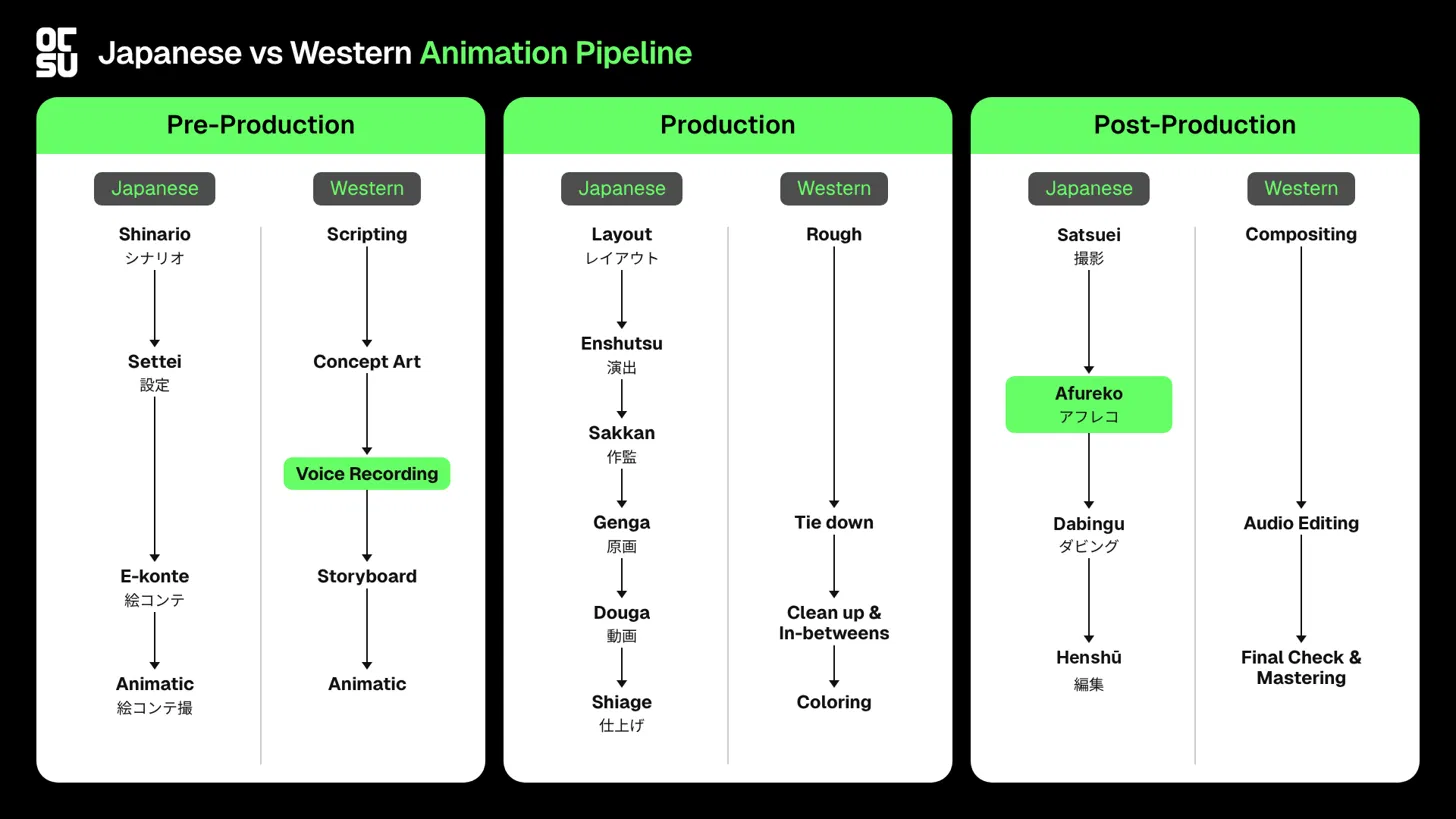
Pre-production is where the two pipelines are most alike. Both build the same foundation, through the same four steps:
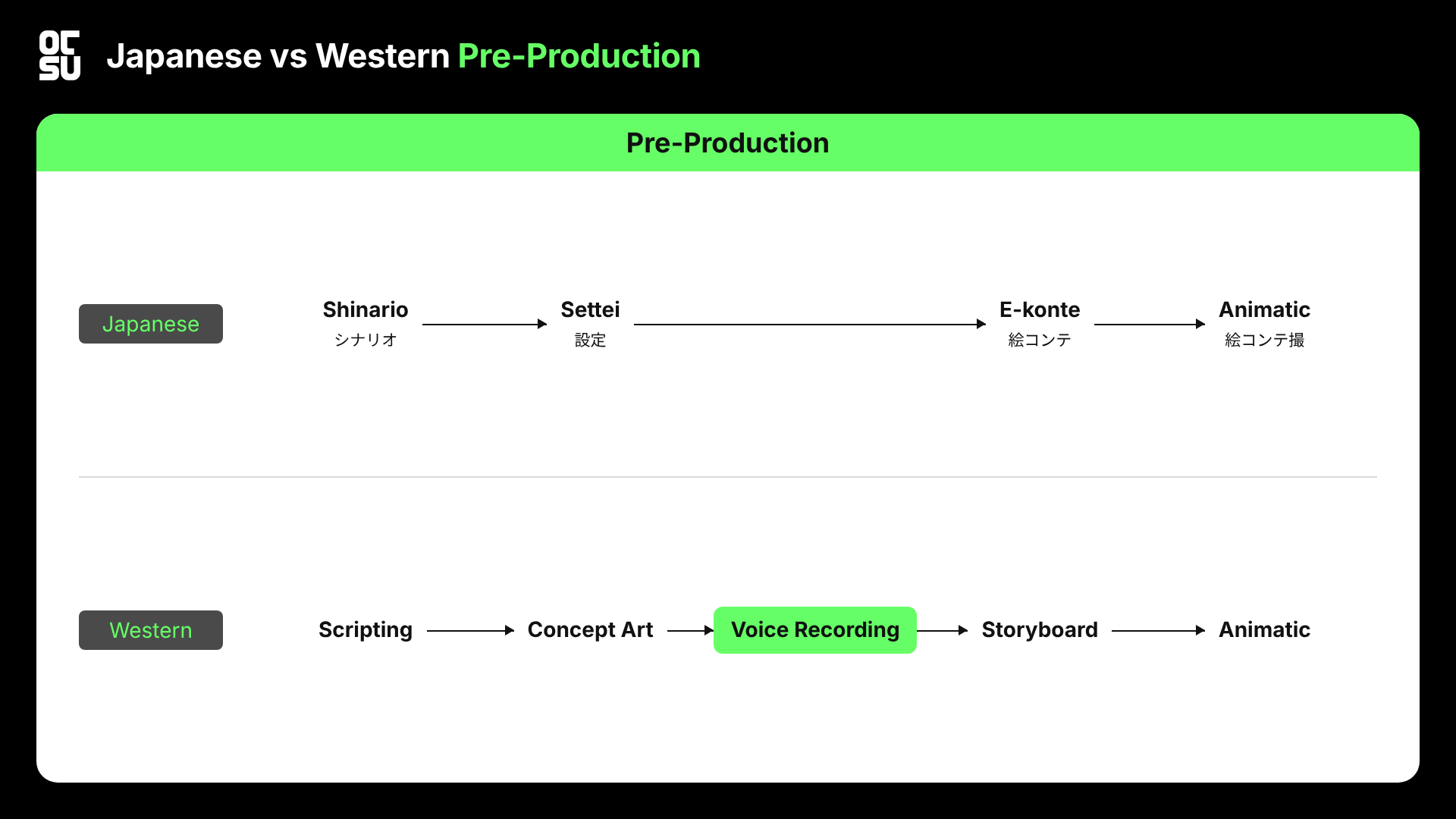
By the end of Pre-production, both teams hold the same things: a locked story, approved designs and a timed animatic that production can build from.
The extra Western step: voice recording
Western productions record dialogue during pre-production, usually after concept art and before the storyboard is finished. The storyboard and animatics are then built around the actors' real performances, and animators later draw to that audio. That is why Western mouth animation can match each line so closely. Japanese productions skip this step here. Voices come much later, in post-production.
Production
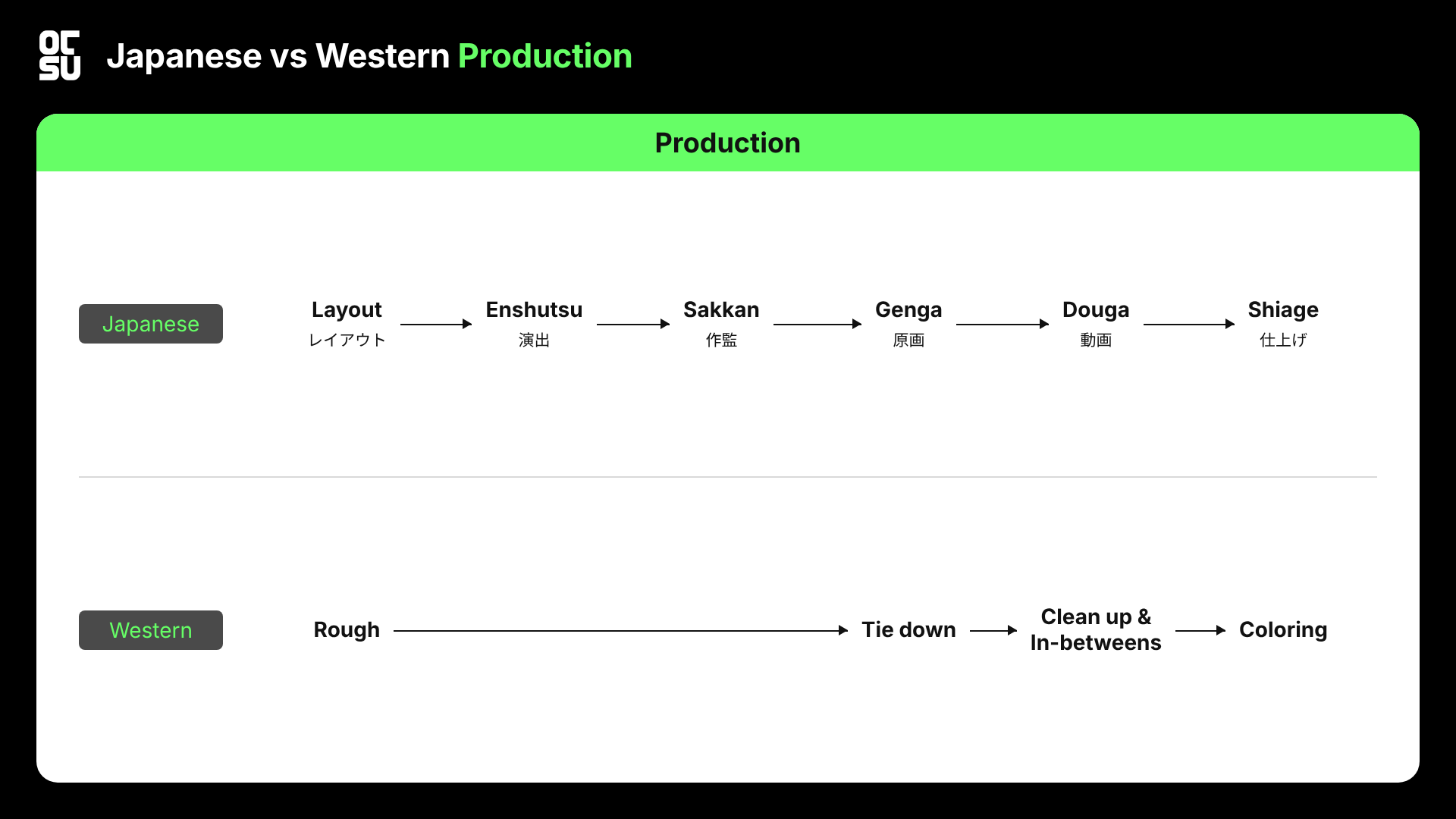
The main difference in production is how many times a drawing is checked before it is final. The Japanese pipeline puts two dedicated review steps in the middle.
**The Western flow**
A Western scene typically moves through four steps:
- Rough: the animator blocks out poses and timing.
- Tie-down: the rough is refined into on-model key drawings.
- Clean-up and in-betweens: final lines are drawn and the frames between keys are filled in.
- Coloring: the drawings are painted.
Review happens throughout, usually by lead or supervising animators, but it is not split out into named stages.
**The Japanese flow**
The Japanese anime pipeline names every checkpoint:
- Layout (レイアウト): the key animator draws the first rough pass of the cut, with camera framing, character placement and the background area. The layout also goes to the background department.
- Enshutsu (演出): the episode director checks the layouts for staging, acting and continuity.
- Sakkan (作監): the animation director corrects key poses so characters stay on model.
- Genga (原画): the key animation is finalized from those corrections.
- Douga (動画): in-betweeners clean up the lines and draw the frames between keys.
- Shiage (仕上げ): the frames are colored.
Why does Japan have so many check points? A single TV anime episode can pass through dozens of key animators, many of them freelancers or partner studios. Work is split by cut, not by character, so one character may be drawn by many hands in one episode. Enshutsu and Sakkan keep that work consistent, catching staging problems and off-model drawings before the expensive frame-by-frame work begins. In practice, the two pipelines differ less in what gets done than in who signs off, and when.
Post-production
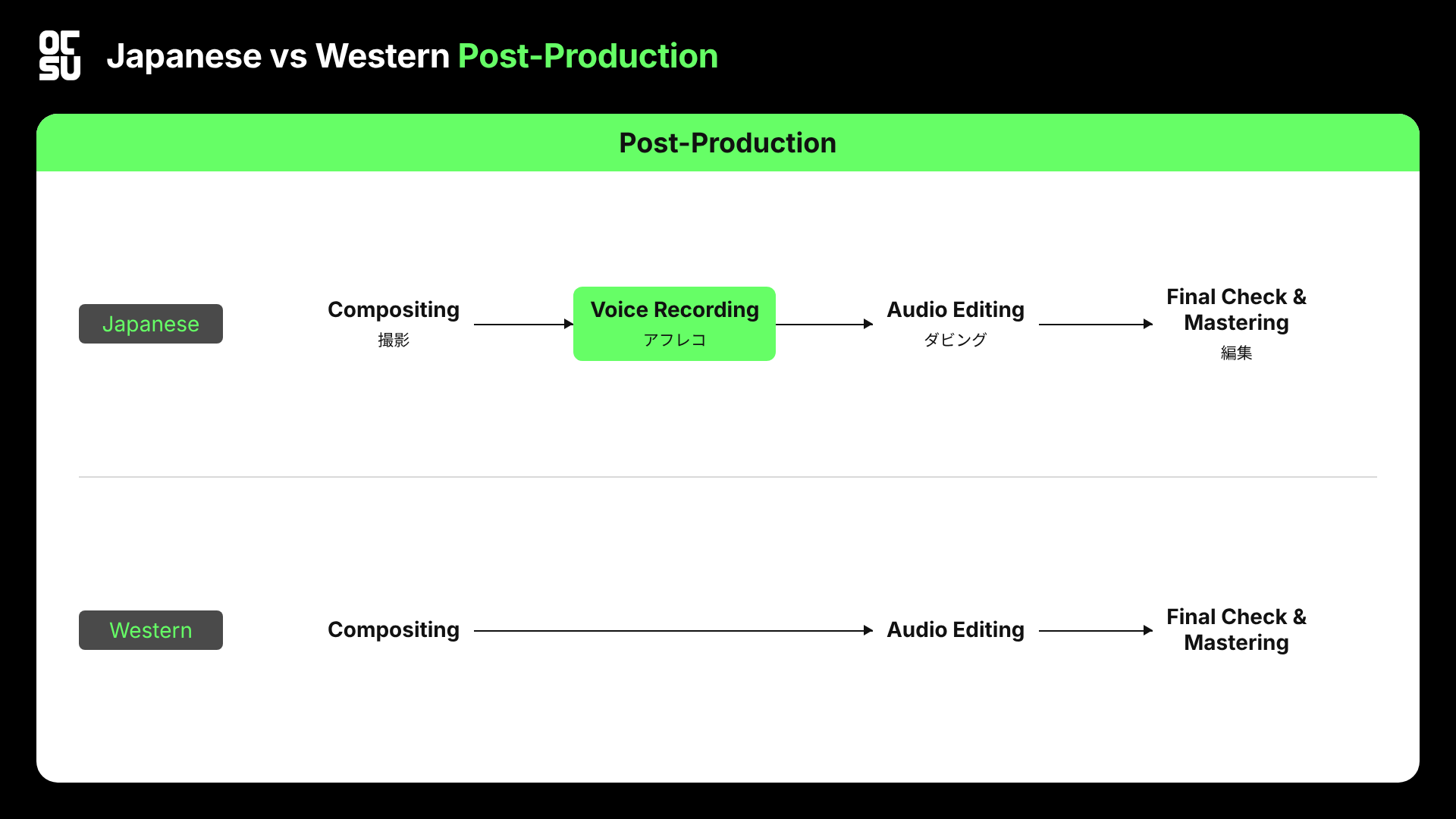
Post-production turns finished animation into a finished film. On both sides it covers the same three jobs: compositing the picture, building the sound, and editing and mastering the final cut. The steps run in nearly the same order. The one big difference is when the voices come in.
Compositing: building the final image
Compositing is where the picture comes together. Colored character frames are layered over the backgrounds, then camera moves, lighting, shadows and effects such as blur, glow and particles are added. Color grading gives each scene its final mood.
The Japanese name, satsuei, means “photography”. It comes from the days when cels were stacked and filmed under a camera. Today it is fully digital, but the satsuei team still plays a big role in a show's look, often adding CG elements and screen effects that define the series' style.
Sound: voice, music and effects
Sound covers everything the audience hears: dialogue, music, sound effects and the final mix that balances them.
In Western productions, the dialogue was recorded months earlier, in pre-production. Post-production adds sound effects and music and mixes them under the existing voice track.
In Japanese productions, this is where voices are recorded, through afureko (“after-recording”). Actors watch the footage and fit their lines to the length of each cut. On tight TV schedules, that footage is often still unfinished, so actors may perform to rough frames or timing cues. The dabingu (ダビング) session then mixes voice, music and sound effects. In the Japanese industry, “dubbing” means this final sound mix, not translation into another language.
Editing and mastering: locking the final cut
The last step is the same on both sides. Editors lock the cut, add titles and credits, and run a final quality check to catch errors or missing frames. The film is then mastered into the formats it will ship in, such as broadcast, streaming or cinema.
In Japan this step is called henshū (編集). On TV anime, it often runs right up to the broadcast deadline, with retakes fixed for broadcast or for the later Blu-ray release.
What the timing of voice recording changes on screen? Because anime voices are recorded after animation, mouth animation is usually simplified to a few shapes timed to each line, rather than matched to each sound. In return, anime voice acting is built around fitting the picture, a skill central to the craft of Japanese voice actors (seiyū).
Which pipeline fits your project?
Neither pipeline is better. Each is built for a different way of making animation: the Western pipeline puts performance first and builds the picture around it, while the Japanese pipeline is built to keep large, distributed teams consistent.
At Otsu, we run a Japanese-influenced pipeline in-house and adapt to Western workflows when a project calls for it. Planning an anime-style project? Talk to the Otsu team about which pipeline fits it.
What is the biggest difference between the Western and anime pipelines?
When voices are recorded. Western studios record dialogue before animation, so animators draw to the performance. Japanese studios record afterward (afureko), so actors perform to the picture.
Why does anime have more review stages?
Anime episodes are split by cut across many key animators, often freelancers. Enshutsu (episode director) and Sakkan (animation director) checks to keep staging and character models consistent across all those hands.
Are anime artists specialists or generalists?
Anime has more named stages, but each artist covers a wider scope within them. A key animator, for example, handles layout, character acting and effects for their cuts.
Can a Western project use an anime pipeline?
Yes. Many studios now run hybrid pipelines, for example recording dialogue early while keeping Japanese-style layout and Sakkan checks.