Cinematic Animation in Video Games: 2D, CGI or Stop Motion
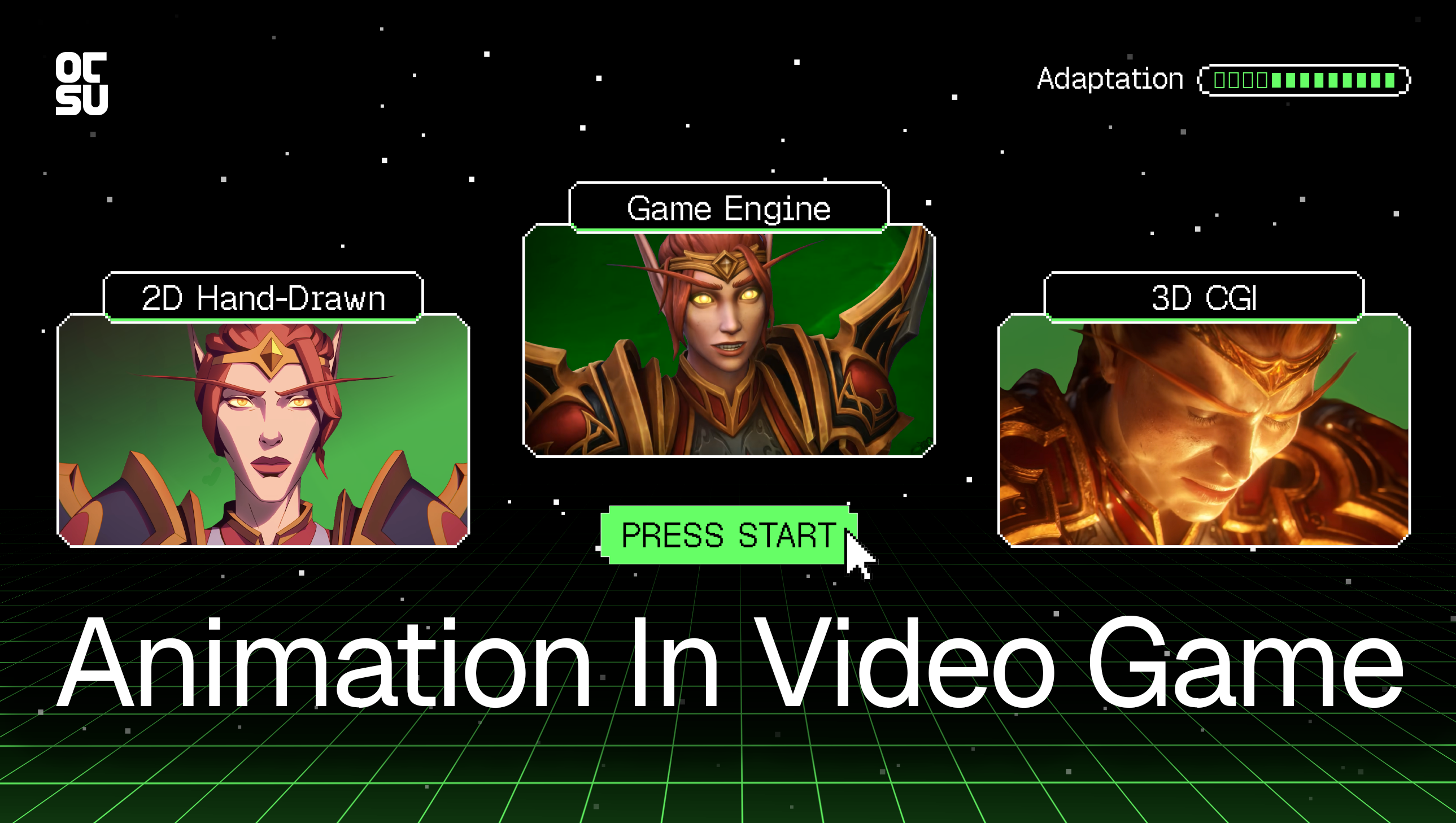
The character Lady Liadrin in World of Warcraft: From 2D to CGI
- 01What a Cinematic Animation Actually Buys You
- 022D Cinematic Animation: When the Line Carries the Feeling
- 03CGI Cinematic Animation: Continuity, Scale and Weight
- 04Stop Motion Cinematic Animation: The Texture of Real Materials
- 05Case Study: Six Chapters, Six Styles in Black Myth: Wukong
- 06Choosing a Cinematic Animation Style Without Guessing
- 07What Separates a Cinematic Animation That Lands
A cutscene asks the player to put the controller down. That is a real cost. It only pays off if what follows could not have been delivered any other way. The most interesting decision in cinematic animation is not whether to include one. It is which visual language the moment deserves. Hand-drawn 2D, CGI or stop motion each carry different meaning before a single line of dialogue lands. Black Myth: Wukong proved a single game can speak all of them.
Meta: How 2D, CGI and stop motion cinematic animation shape storytelling in games, plus a breakdown of the six chapter-ending shorts in Black Myth: Wukong.
What a Cinematic Animation Actually Buys You
During gameplay the camera belongs to the player. They can face a wall during your best-lit moment. They can sprint past the reveal. The engine also has to render whatever they choose to look at, right now, without dropping frames.
A cinematic animation removes both problems at once, which is the whole reason the form exists. The camera becomes fixed and deliberate. Lighting can be built for one composition instead of every possible composition. Detail that would melt a device in real time becomes affordable because the shot is authored rather than improvised.
That is the trade. The player surrenders agency. In return they should receive something gameplay physically cannot give them: a performance, a piece of history, a reveal framed exactly as intended.
When cinematics are disliked, it is almost always because that trade was broken. Long unskippable scenes stall pacing. Sudden quick time events force players to watch for a prompt instead of watching the scene, which is why they tend to land worse than an uninterrupted sequence. The rule underneath every good cinematic animation is simple. Every second of lost control has to be repaid.
2D Cinematic Animation: When the Line Carries the Feeling
Two-dimensional cinematic animation is the strongest choice when a moment needs to be read as symbol rather than simulated as space.
Line weight, shape language and colour do the emotional work directly. A brushstroke can suggest violence without depicting it. A flat background can hold a character in isolation more effectively than a fully modelled room. Because nothing has to obey physical plausibility, 2D can push exaggeration until the feeling reads instantly.
There is a second reason studios reach for 2D cinematic animation. Dropping into 2D inside a 3D game announces a change in the layer of reality. Memory, legend, dream, prophecy and backstory all sit naturally in a different medium. The player understands the shift before anyone explains it.
The craft trap is treating 2D as the cheap option. Good 2D cinematic animation still depends on allocation, the same discipline that shapes anime production. Not every shot needs a new drawing per frame. A held pose can hit harder than continuous motion. Frames get concentrated where impact matters and pulled back everywhere else, which is what makes the expensive moments feel expensive.
CGI Cinematic Animation: Continuity, Scale and Weight
CGI is the default for cinematic animation in most productions. The reasons are practical. When a cutscene uses the same models, rigs and environments as the game, the transition can be nearly invisible. Players often notice only because control has quietly been taken away. That continuity protects immersion in a way no other technique can match.
It also handles what 2D struggles with. Complex camera moves through architecture. Genuine spatial depth. Physical weight in a collision. Cloth, hair and lighting that behave consistently across dozens of scenes. Reusable assets that can be shot from any angle without redrawing anything.
Within CGI cinematic animation there are two approaches worth separating. Motion capture records real performers and excels at nuance, especially facial acting and the small imperfections that make a body read as alive. Keyframe animation defines the critical poses and interpolates between them, which gives far more room for exaggeration and stylisation. Realistic drama tends toward mocap. Anything heightened, comic or superhuman tends toward keyframe. Most productions use both.
The risk with CGI cinematic animation is sameness. Photoreal is the most crowded aesthetic in the medium. A technically flawless render with no point of view is forgettable. A polished shot still needs a strong layout so the audience knows where to look.
Stop Motion Cinematic Animation: The Texture of Real Materials
Stop motion cinematic animation carries something renders only approximate. Real clay holds fingerprints. Real fabric has weave. Light behaves on physical materials in ways that read as handmade. Audiences feel that care even when they cannot name it.
It is also brutally slow. Puppets are moved in tiny increments and photographed frame by frame. A single mistake can mean reshooting an entire sequence.
Which is why the honest version of this story is more interesting. Most stop motion cinematic animation in games is a look achieved through hybrid means rather than literal frame-by-frame shooting. Harold Halibut, released in 2024 by German studio Slow Bros. after more than a decade of work, is the clearest example. Every set, prop and character was physically sculpted, carved, sewn and painted, then 3D scanned into Unity and animated digitally with motion capture and hand animation. The team experimented with real stop motion early and found it incompatible with gameplay.
The detail worth stealing is how they preserved the feel. Rather than interpolating smoothly between poses the way digital animation normally does, they cut the frame rate and stepped between keyframes, especially on facial animation. What sells stop motion is not the material. It is the timing.
Other approaches exist. Kong Orange shot Vokabulantis with physical objects, which let cutscenes and gameplay match visually because the characters were the same puppets in both. The lineage runs back through The Neverhood in 1996 and its claymation contemporaries.
Case Study: Six Chapters, Six Styles in Black Myth: Wukong
Game Science shipped Black Myth: Wukong in August 2024 as a photoreal Unreal Engine 5 action game. Then it closed every chapter with a cinematic animation that looked nothing like the game.
Six chapters, six shorts, six distinct visual languages. Collectively titled Six Roots, they were released as standalone films on YouTube in September 2024. On Bilibili the collection drew a 9.9 out of 10 rating and views in the tens of millions, which is worth noting on its own: the cinematics became content people watched without playing the game.
A quick correction to a common claim. These were not one studio per short. Game Science worked with several leading Chinese animation teams. Guangzhou-based Big Firebird Cultural Media co-produced three of the six.
What each style was doing:
Chapter one, "I See", came from Shanghai studio FLiiiP Design under director Lin Zhe. It draws on lianhuanhua, the traditional Chinese illustrated storybook format, together with the house style of the classic Shanghai Animation Film Studio era. The subject is Elder Jinchi's slow corruption by greed. It is a moral fable. The folk-illustration register fits a fable exactly.
Chapter two, "Deaf Ear", is stop motion with physical puppets, directed by Weng Jie. Production ran roughly six months with only three or four animators, every movement planned in advance because one error means starting the shot again. The story follows a scholar who rescues a wounded white fox that later takes human form. Note the staging choice: the chapter itself is set in desert while the short is set in snow. The rupture is intentional.
The remaining shorts move through ink wash, gongbi realist brushwork and other traditional Chinese techniques, with chapter six, "Unfinished", produced by Fantasier Animation.
Four things made this cinematic animation programme work. All of them transfer to any project.
Style carried meaning instead of decorating it. A fable got folk illustration. A ghost story got the tactility of puppets. The medium set the register before the narration started.
Placement respected the player. Each short arrives after a hard boss, at the moment a player most wants to sit back. Positioning a cinematic animation where exhaustion peaks turns it into a reward rather than an interruption.
Cultural specificity travelled further than generic polish. International players who had never heard of lianhuanhua responded to these shorts precisely because they were not neutral.
Someone chose to pay for it. Six bespoke styles cost more than one consistent pipeline. Game Science treated the shorts as part of the product rather than as an extra. They became the most shared thing about the game.
Choosing a Cinematic Animation Style Without Guessing
Most cinematic animation style debates go in circles because the question is framed as a preference. Reframe it as a series of decisions and the answer usually appears.
Start with the layer of reality your cinematic animation occupies. Does this moment happen in the same world as gameplay, in the present tense? Then CGI matching the engine protects continuity. Is it memory, myth, backstory or something told rather than lived? A different medium marks the shift for free.
Then ask what the audience needs to read. Space, distance and physical consequence point to 3D. Symbol, emotion and compression point to 2D. Tactile warmth and handmade presence point to a stop motion look.
Decide whether you want continuity or rupture. A seamless transition keeps players inside the world. A hard cut into another medium tells them to lean back and receive something. Both are valid. Choosing by accident is not.
Then be honest about budget. A different style for every beat is a real cost multiplier, in art direction as much as in production hours. It is worth it when the styles mean something. It is waste when they are variety for its own sake.
Finally, decide placement and length before production. Openings set tone and world. Mid-gameplay beats work best when the seam barely shows. Chapter and act endings can afford the biggest swing, because the player has earned the pause.
What Separates a Cinematic Animation That Lands
The decisive work happens in the storyboard, long before rendering. Framing, shot length and rhythm get locked there. A cinematic animation that fails usually failed at boards and got expensive later trying to fix it in polish.
Sound is the other half of any cinematic animation. It is routinely underweighted. Score, ambience and dialogue carry as much of the emotional load as the image. Silence is a tool too. Cutting sound entirely can generate more unease than any visual effect.
Everything else follows from one question: what does this shot need the player to feel? Not what would look impressive. Not what shows off the pipeline. A camera move without a reason becomes decoration. Audiences read decoration as filler.
This is how Otsu approaches cinematics, whether the brief calls for 2D, CGI, stop motion or a hybrid of them. Style is a storytelling decision made at the boards, not a finish applied at the end.
Looking for a partner who treats every frame as a choice, not just motion, in 2D, 3D or hybrid? Otsu Labs is the animation studio built for exactly this. Contact us now!
What is cinematic animation in video games?
Authored, non-interactive footage with a fixed camera and controlled lighting. Because the shot is planned rather than improvised by the player, it carries detail and performance that real-time play cannot sustain.
What is the difference between 2D and 3D cinematic animation in games?
2D reads as symbol and suits memory, myth or backstory. 3D preserves spatial continuity with gameplay and handles scale, camera moves and physical weight.
Which video games use stop motion animation?
Harold Halibut by Slow Bros. is the best-known recent example, built from handcrafted models that were 3D scanned. Vokabulantis shot physical objects directly, and The Neverhood pioneered claymation in games in 1996.
Why does Black Myth: Wukong use different animation styles for each chapter?
Each style matches its story's register, from folk illustration for a fable to stop motion puppetry for a ghost tale. The shift also separates backstory from the photoreal world of gameplay.
How much does a cinematic animation cost for a game?
It depends on style, length and how much is shared with the game. Reusing existing rigs and environments is cheapest, while a bespoke 2D or stop motion short is a separate production.
Should cutscenes be skippable in video games?
Generally yes. Unskippable scenes are among the most common player complaints, and making them skippable costs almost nothing.