Anime Adaptations Based on Video Games: What Are the Challenges?
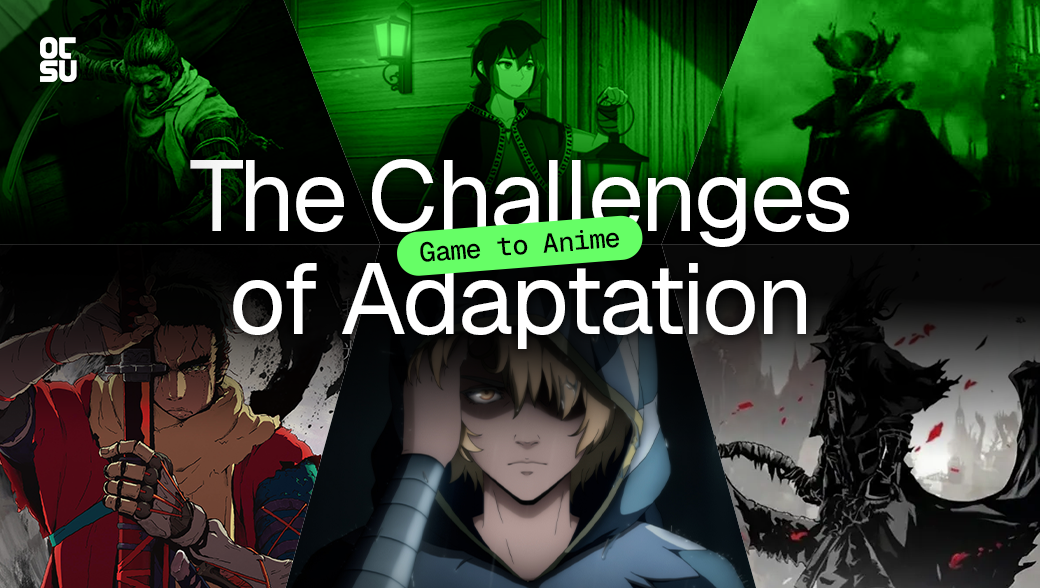
Sekiro: No Defeat, Bloodborne, Ghost of Tsushima: Legends. 2026 is shaping up to be the year of anime adaptation based on video games. But with our experience in animation production, this process is harder than any announcement event makes it look. Here’s the view from inside the industry.
A Big Year for Anime Adaptation Based on Video Games
Otsu Animation has taken part in many discussions between animation studios and game publishers. One side brings love for the IP. The other brings hundreds of hours of player data, lore as thick as an encyclopedia. There’s one question that always surfaces: “How do we not ruin this?”.
In 2026, this question is being asked more often than before. Sekiro: No Defeat was screened at the Annecy International Animation Film Festival and received a positive early response. It will open in Japanese theaters on September 4. Bloodborne was announced as an R-rated animated film by Sony Pictures at CinemaCon. Ghost of Tsushima: Legends revealed its first official posters at Anime Expo, with a planned release on Crunchyroll in 2027. These are three different projects from three different studios. But each one carries the same challenge: turning something built to be played into something built to be watched.
This is not a new attempt for the industry. For many years, video game movie adaptations had a poor reputation. Many early adaptations, going back to Super Mario Bros. in 1993, were considered failures. It took later projects - The Last of Us, Fallout and the Super Mario Bros. Movie - to change that perception through strong reviews and box office results. However, one fact is rarely mentioned in press coverage: the real success rate of anime adaptation based on video games is much lower than the announcement events suggest. The reason isn’t talent or budget. It comes from the nature of adaptation itself.
Three Challenges Every Studio Faces
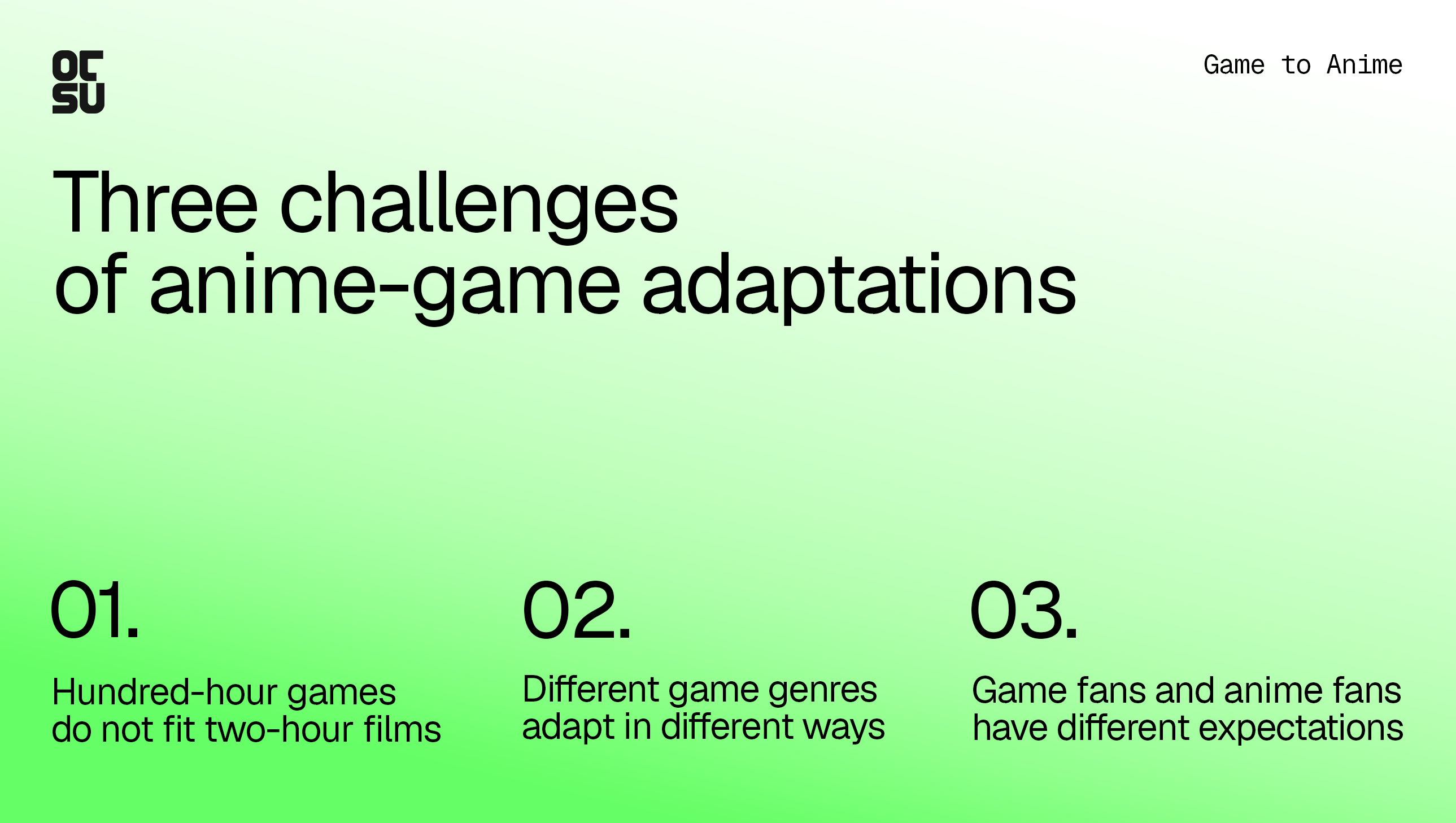
Hundred-Hour Games Do Not Fit Two-Hour Films
A typical AAA game takes 40 to more than 100 hours to complete. An animated feature film runs about 100 to 115 minutes. This is a serious compression problem. There are only trade-offs.
Sekiro: No Defeat shows this clearly. According to reviews from the Annecy screening, the theatrical version has already removed several boss fights that appeared in earlier trailers. There was simply not enough time to include them. It also appears that the production is creating two different versions of the story. The theatrical version focuses on the relationship between Sekiro (Wolf) and Kurō and it is edited for pacing. A longer version, expected for streaming release, is reported to follow the game’s structure more closely, with a slower and looser narrative.
That’s a conscious choice. When a team cannot include everything, they must decide which part of the story deserves the most attention, instead of trying to include every part at a lower quality. For a game like Sekiro, which has a clear beginning, middle and end, this decision is already difficult. For open-world games without one main storyline, it becomes far more difficult. There is no single, obvious narrative structure to build the film around. The team has to decide what the story is actually about before any animation work begins. This decision cannot be made later, during editing.
Different Game Genres Adapt in Different Way
This is something that many first-time IP holders underestimate: the original structure of the game strongly affects how difficult the adaptation will be. This is true even before an animation studio starts working on the first storyboard.
Visual novels are already linear and script-based, with fixed dialogue. This makes them relatively easier to adapt because there is little need to redesign the narrative structure. However, most AAA games today are not visual novels. They are open systems. Players learn about the game world through direct experience, trial and error and free exploration. When this freedom is removed and the story is forced into a straight, linear format, an active experience becomes a passive one. Much of what made the original game meaningful comes from that sense of control, which is difficult to recreate on screen.
This is why Arcane (anime adaptation based on the games League of Legends) is worth studying closely. It is one of the few adaptations that succeeded by every major measure. Arcane never tried to retell a match. League of Legends barely has a linear narrative to adapt in the first place. Instead, Fortiche (the French animation studio) and Riot Games used the game’s world as a foundation and built an entirely new, original story around two characters, Vi and Jinx. The results speak for themselves:
- Two Emmy Awards for Outstanding Animated Program (2022 and 2025).
- A perfect Rotten Tomatoes score for both seasons.
- According to Variety, a production budget of approximately 250 million US dollars across 18 episodes. This makes Arcane the most expensive animated series ever produced. Fortiche and Riot Games spent almost nine years completing the project.
The lesson here isn’t: “Spend enough money and you'll win”. It’s this: When a game has no clear linear narrative to lean on, don’t force it into a shape it was never built for. Instead, use the game’s world as material to build a new story that stays true to its spirit.
Game Fans and Anime Fans Have Different Expectations
An audience coming from manga usually expects an 1:1 adaptation because manga and anime are both linear storytelling, just in different media. Audiences coming from games understand that’s impossible. Game mechanics such as exploration, item collection and player-controlled combat cannot be shown directly on screen. Some parts of the original experience will always be lost in the adaptation process.
That’s why choosing the right material to adapt matters as much as choosing the right production partner. Ghost of Tsushima: Legends makes a smart call here: instead of adapting the main storyline (Jin Sakai’s arc), the production team - director Takanobu Mizuno (Star Wars: Visions), writer Gen Urobuchi (Fate/Zero, Madoka Magica) and character designer Takashi Okazaki (Afro Samurai) - chose to adapt the Legends co-op mode, where the plot shifts depending on the players’ actions rather than following a fixed script. Because the source material has fewer fixed plot requirements, the writing and animation teams have much more creative freedom than they would have (if they tried to stay fully faithful to a storyline that fans already know by heart).
When Anime Adaptation Makes Sense and When It Doesn’t
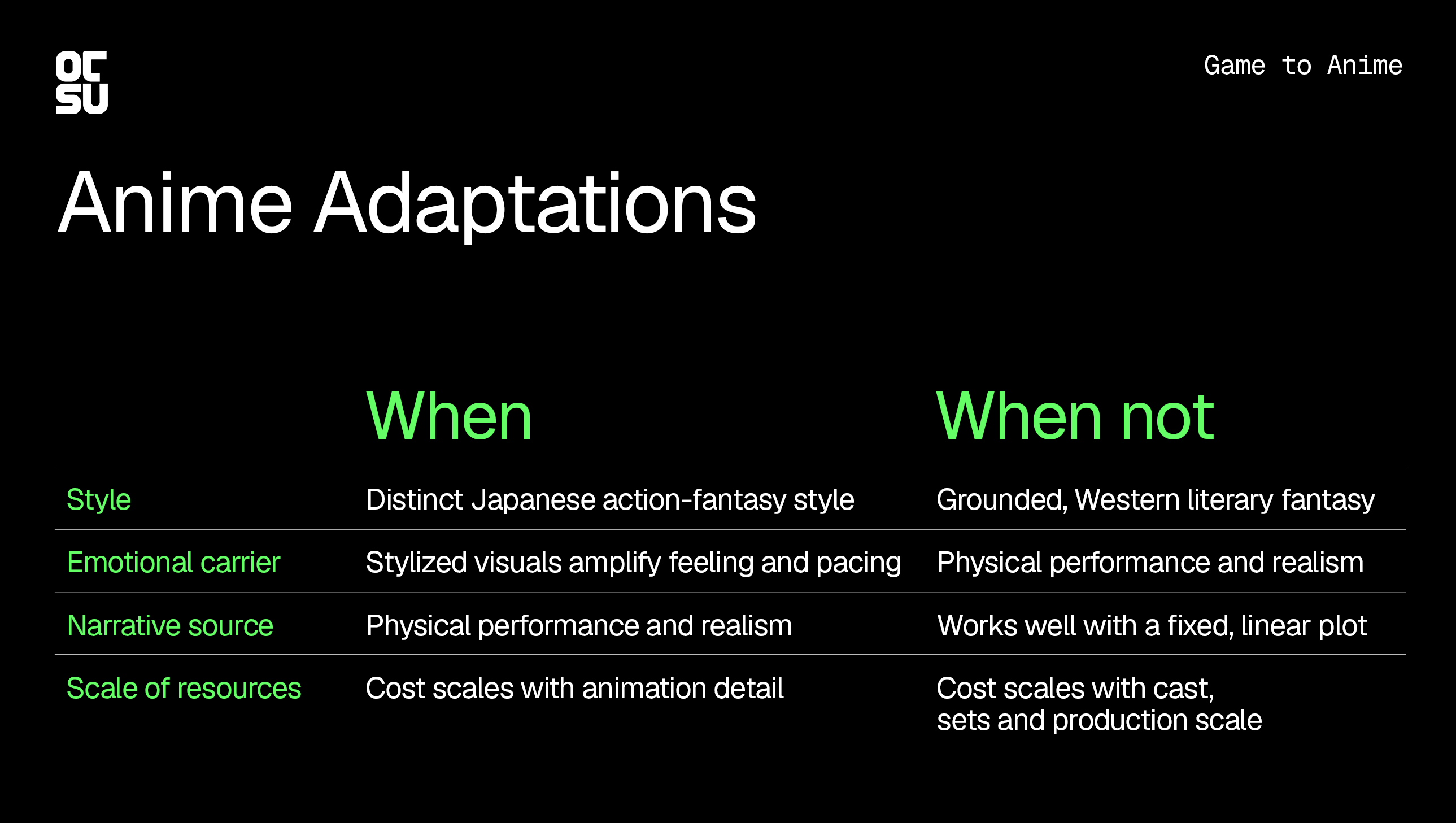
Here’s something IP holders rarely say out loud: animation is not always the best choice. Elden Ring, one of the most successful dark fantasy RPGs of the decade with more than 30 million copies sold, is being adapted by A24 as a live-action film. It is written and directed by Alex Garland, known for Civil War and Ex Machina. The reported budget is more than 100 million US dollars, with a release date set for March 3, 2028.
This does not deny everything said above. It supports the same principle from a different angle: the format of an anime adaptation should match the nature of the original IP, not current industry trends. Elden Ring leans into grounded dark fantasy, its world co-built by George RR Martin in a style closer to Western literary fantasy. This kind of material fits well with a large-scale live-action production. Sekiro, Bloodborne and Ghost of Tsushima, in comparison, have a strong Japanese visual and narrative style. This style translates naturally into anime and 2D animation, where a distinctive visual approach can strengthen emotional impact and combat pacing more effectively than live-action can, at a similar production cost.
A strong animation partner does more than know how to adapt a property. They also know when to tell a clientclearly and directly, that animation is not the correct format for a specific project. This can be a difficult message to deliver when a contract is already being discussed. However, this kind of honest judgment is exactly what separates a long-term creative partner from a vendor. The best results we have seen come from teams that are willing to raise this concern early, even if it means turning down work that is not the right fit.
What Should You Look for in an Adaptation Partner?
Based on the three challenges above, here are practical points that any IP holder, whether a major publisher or an indie studio, should look for an animation partner:
- They should understand how games tell stories, not only how games look visually. A strong partner can identify which part of the story is essential to keep and which details can be removed without losing the spirit of the original. This is similar to how the Sekiro: No Defeat team chose to build the theatrical version around the relationship between Wolf and Kurō.
- They should know how to select the right material when the full IP is too large to adapt directly. It is not always necessary to adapt the main storyline. Side stories, alternate game modes or an entirely new story inspired by the game’s world - as seen with Arcane - are all proven and valid approaches.
- They should maintain a visual identity connected to the original game world. Color, movement and character expression need to reflect the true tone of the game. Animation that looks low-quality or inconsistent can quickly break the trust of fans.
- They should be willing to say no when necessary. Not every IP is suitable for animation. A partner who truly understands the industry will help you avoid costly and misguided decisions before they’re locked in.
- They should balance production speed with production quality. This is often the most underestimated factor. Arcane took almost nine years to complete two seasons. This is an extreme case, but it reflects a real limitation: high-quality, distinctively styled animation cannot be rushed in the same way as standard production work. A reliable partner sets realistic timelines from the earliest planning stage, instead of promising an unrealistic deadline to close a deal and allowing quality to suffer later in production.
- They should be transparent about budget trade-offs. Not every project has a budget close to Arcane’s. However, the same principle applies at every budget level: episode count, animation detail and faithfulness to the originals are always in tension with one another. An experienced partner will explain these trade-offs clearly, in plain language, before a contract is signed, not after production has already started.
- They should be able to show relevant, comparable past work. Ask to see previous projects that involved a similar challenge. A partner who can clearly explain why a past project made specific creative choices is a much stronger signal of expertise than a partner who can only show finished footage without context.
This Is the Time to Focus on Quality, Not Just Speed
The 2026 wave of anime adaptations is not a short-term trend to follow quickly. It is a sign that this part of the industry is maturing and that game developers and animation studios are being required to understand each other’s creative language more deeply. A project like Arcane did not succeed within a single year. Fortiche and Riot Games spent nearly a decade making sure it was done correctly and that level of patience is often missing from projects that move too quickly.
We have worked with partners across the game industry, from indie studios to industry-leading developers. The clearest pattern we have observed is this: successful projects always begin with an honest conversation about what should and should not be adapted. Projects that struggle often skip this conversation entirely. They move directly from “We have an IP” to “Let’s produce a trailer”, without first asking whether the story can actually survive the transition to a new medium.
If you are considering bringing your IP to the screen, whether as a full series or a shorter project, we recommend having this conversation before deciding on a final format. In some cases, the right answer will not be animated. But when animation is the right choice, we have the experience to help you do it well.
What is an anime adaptation based on video games?
It translates a video game’s story, characters or world into an anime series or film to reach a broader audience by using anime’s storytelling strengths.
How long does it take for an anime adaptation?
The production timeline depends on scale and quality. Smaller-budget projects progress quickly, but distinctive, high-quality animation requires more time.
Does an adaptation need to follow the original game’s story?
No. Successful adaptations like Arcane and Ghost of Tsushima: Legends don’t follow the original story.
How can you tell if an IP is a good fit for animation?
It depends on narrative structure. Linear storylines are easier to adapt, while open-world games without a central narrative work best with an original story built around the game’s world.
What to look for in an animation partner for adaptation?
Your adaptation partner should understand both game and anime storytelling. They know when to adapt or innovate and offer honest guidance on budgets, timelines and format suitability.